
 UAE
UAE
 Qatar
Qatar
 Pakistan
 KSA
KSA
 Oman
Oman
 Kuwait
 Bahrain
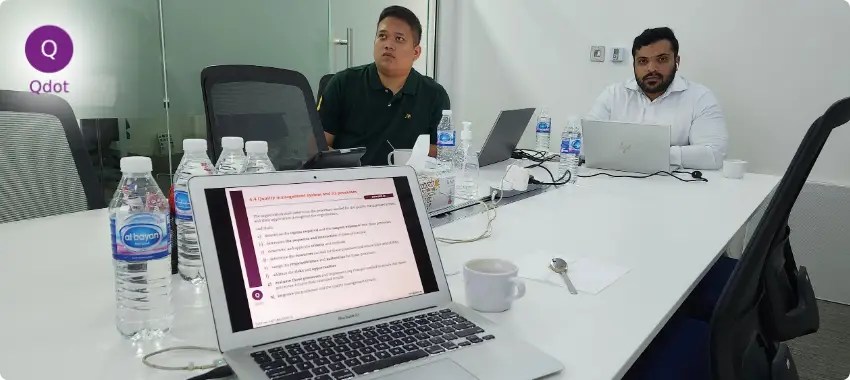
ISO 9001 certification in Qatar is an independent confirmation that an organization has implemented a Quality Management System (QMS) that meets the requirements of ISO 9001. Qdot helps organizations prepare the QMS, documentation, internal audit, management review and evidence needed before the external certification audit.
Qdot is an ISO consultancy firm, not a certification body. An independent accredited certification body conducts the Stage 1 and Stage 2 audits, makes the certification decision and issues the certificate.
Current standard status: ISO 9001:2026 is the current published edition, released on 16 September 2026, and it replaces ISO 9001:2015. From 31 March 2028, new and initial accredited certifications may only be issued to ISO 9001:2026. Organizations already certified to ISO 9001:2015 have until 30 September 2029 to complete their transition. For Qatar-specific transition guidance, see our ISO 9001:2026 update for Qatar.
What Does ISO 9001 Certification Confirm?
ISO 9001 certification confirms that the organization has established and operates a QMS for consistently meeting customer, contractual and applicable statutory or regulatory requirements. The audit considers leadership, process control, risk-based thinking, competence, documented information, customer satisfaction, internal audit, management review, corrective action and continual improvement.
Certification does not guarantee that every product or service will be error-free. It provides independent assurance that the organization has a structured system for controlling work, monitoring performance and addressing problems.
Is ISO 9001 Certification Mandatory in Qatar?
ISO 9001 is not legally mandatory for every organization in Qatar. It may nevertheless be required or preferred by a customer, tender, vendor-registration system, main contractor or corporate procurement policy. The exact requirement should always be checked in the relevant contract, prequalification checklist or tender document.
Organizations also pursue certification voluntarily to improve process consistency, strengthen accountability, reduce recurring errors and demonstrate a formal commitment to quality.
Who Is Responsible for Each Part of the Certification Journey?
| Party | Main responsibility |
|---|---|
| Client organization | Owns and operates the QMS, approves documents, provides resources, maintains records and closes corrective actions. |
| Qdot | Provides gap analysis, implementation guidance, documentation support, awareness, internal-audit support and certification-readiness preparation. |
| Independent certification body | Plans and conducts the certification audit, reviews corrective actions, makes the certification decision and issues or maintains the certificate. |
Organizations needing hands-on implementation assistance can review Qdot's ISO 9001 consultancy in Qatar. The consultancy and certification functions remain separate.
How to Get ISO 9001 Certification in Qatar
The route to certification depends on the organization's scope, size, process complexity, number of sites and current level of readiness. A typical project follows these stages:
| Stage | What happens | Typical evidence or output |
|---|---|---|
| 1. Define the QMS scope | Confirm the legal entity, locations, activities, products, services and relevant processes. | Approved QMS scope and process boundaries |
| 2. Complete a gap analysis | Compare current practices and records with ISO 9001 requirements. | Prioritized gap report and action plan |
| 3. Develop the QMS | Create or improve policies, process controls, responsibilities, forms and records. | Controlled QMS documentation |
| 4. Implement the system | Train process owners, operate the controls and collect objective evidence. | Operational and performance records |
| 5. Conduct internal audit | Check whether the QMS conforms to planned arrangements and is effectively implemented. | Audit plan, findings and corrective actions |
| 6. Hold management review | Top management reviews QMS performance, risks, objectives, audit results and improvement needs. | Management-review decisions and actions |
| 7. Select a certification body | Confirm the body's accreditation route, competence, proposal, audit time and schedule. | Certification agreement and audit plan |
| 8. Complete Stage 1 and Stage 2 | The certification body reviews readiness and then evaluates implementation. | Audit reports and any required corrections |
| 9. Certification decision | The certification body reviews the audit outcome and accepted corrective actions. | Certificate, when the decision is positive |
What Happens During the Stage 1 and Stage 2 Audits?
Stage 1: Readiness and System Review
Stage 1 normally reviews the QMS scope, key documented information, site conditions, internal audit, management review and readiness for the main assessment. The auditor may identify areas that must be addressed before Stage 2.
Stage 2: Implementation and Effectiveness
Stage 2 evaluates how the QMS operates in practice. Auditors interview employees, sample records, observe activities and check whether processes are controlled and effective. Findings may need correction and corrective action before certification can be granted.
What Affects ISO 9001 Certification Cost in Qatar?
There is no single fixed fee for every organization. Consultancy fees and certification-body audit fees are separate and depend on the approved scope.
| Cost factor | Why it matters |
|---|---|
| Number of employees | Certification bodies use effective personnel and other complexity factors when calculating audit time. |
| Number of sites | Additional locations may require site visits, sampling or extra audit time. |
| Activities and process complexity | Manufacturing, construction, design or regulated work may require broader technical review. |
| Existing QMS maturity | An established system may need less implementation work than a new or incomplete QMS. |
| Consultancy scope | Gap analysis only, full implementation, training and internal-audit support have different resource requirements. |
| Certification-body proposal | Audit time, accreditation route, travel and surveillance arrangements affect the independent audit fee. |
Qdot can review the organization profile and provide a consultancy proposal. The certification body should provide its own separate audit quotation.
How Long Does ISO 9001 Certification Take?
The timeline depends on current readiness, management availability, process complexity, number of sites, speed of implementation and the certification body's audit schedule. A company with an operating QMS and reliable records may progress faster than an organization starting without defined processes.
No consultant can responsibly guarantee a fixed certification date or audit result. A realistic plan should allow enough time to operate the system, complete internal audit and management review, close gaps and schedule the independent audits.
Which Documents and Records Are Commonly Reviewed?
ISO 9001 does not require the same document set for every organization. The QMS should contain documented information that is necessary for effective process control and evidence of conformity.
- QMS scope, quality policy and measurable quality objectives
- Process maps, responsibilities and operational controls
- Risk and opportunity records
- Customer requirements, feedback and complaint records
- Supplier selection, evaluation and monitoring records
- Competence, training and awareness evidence
- Inspection, service-delivery or production records where applicable
- Monitoring, measurement and KPI results
- Internal-audit programme, reports and follow-up
- Management-review minutes, decisions and assigned actions
- Nonconformity, root-cause and corrective-action records
How Can an Organization Prepare for the Certification Audit?
Before Stage 1, confirm that the QMS scope is accurate, controlled documents are approved, required records are available, internal audit and management review have been completed, and open actions have clear owners and deadlines. Before Stage 2, verify that staff understand their roles and that process records demonstrate consistent implementation.
Organizations can use Qdot's guide to common ISO 9001 audit findings in Qatar to identify frequent evidence and implementation gaps before the external audit.
Who Commonly Uses ISO 9001 Certification in Qatar?
ISO 9001 can be used by organizations of any size in construction, engineering, trading, manufacturing, logistics, facility management, healthcare, IT, food services, oil and gas supply chains and professional services. The need is usually driven by customer expectations, tenders, vendor registration, growth or internal improvement goals.
For tender timing, certificate-scope checks and sector examples, read who may need ISO 9001 before tender submission in Qatar.
How Long Is an ISO 9001 Certificate Valid?
Accredited management-system certification normally follows a three-year cycle, subject to continuing surveillance and satisfactory maintenance of the QMS. The certification body establishes the surveillance schedule and conducts recertification before the end of the cycle.
Certificate users should check the legal entity, certified locations, scope, standard edition, issue and expiry dates, certification-body details and current certification status. Tender-specific acceptance requirements may be stricter, so the relevant buyer's documents should be reviewed.
ISO 9001 Certification Support in Doha and Across Qatar
Qdot supports organizations in Doha, Lusail, Al Rayyan, Al Wakra, Al Khor, Mesaieed, Ras Laffan, Dukhan, Industrial Area and other business locations across Qatar. Delivery may include onsite visits, remote coordination or a blended approach based on the project scope.
Organizations seeking locally focused assistance can also review Qdot's ISO 9001 certification support in Doha.
How Qdot Supports ISO 9001 Certification Preparation
- Readiness assessment: Review the current QMS and prioritize gaps.
- Implementation support: Develop practical controls, documents and responsibilities with the client's team.
- Awareness and process-owner guidance: Help relevant staff understand what they need to operate and evidence.
- Internal-audit and management-review support: Prepare objective evidence and improvement actions.
- Certification-readiness review: Check open gaps and organize evidence before the independent audit.
- Post-certification support: Assist with surveillance readiness, corrective actions and QMS improvement.
Talk to Qdot About ISO 9001 Certification Preparation
If your organization needs professional support to prepare for ISO 9001 certification in Qatar, Qdot can review your scope, current processes, documentation status and audit-readiness needs. Qdot provides implementation and certification-preparation support; the independent certification body remains responsible for the audit and certification decision.
FAQs
The company defines its QMS scope, implements ISO 9001 requirements, operates the system, completes internal audit and management review, and then passes Stage 1 and Stage 2 audits conducted by an independent certification body.
No. Qdot provides consultancy, implementation and certification-readiness support. An independent accredited certification body conducts the audit, makes the certification decision and issues the certificate.
Cost depends on employee numbers, sites, activities, process complexity, current readiness, required consultancy scope and the independent certification body's audit proposal. Consultancy and certification-body fees should be quoted separately.
The timeline depends on QMS readiness, management participation, process complexity, number of sites, corrective actions and certification-body availability. A fixed date should not be promised before the scope and readiness are reviewed.
It is not mandatory for every organization. It may be required or preferred by a tender, customer, vendor-registration system, main contractor or corporate procurement policy.
Accredited management-system certification normally follows a three-year cycle, subject to surveillance audits and continued conformity. Recertification is completed before the end of the cycle.
ISO 9001:2026 is the current published edition, released on 16 September 2026. From 31 March 2028, new and initial accredited certifications may only be issued to ISO 9001:2026, while organizations already certified to ISO 9001:2015 have until 30 September 2029 to complete their transition.